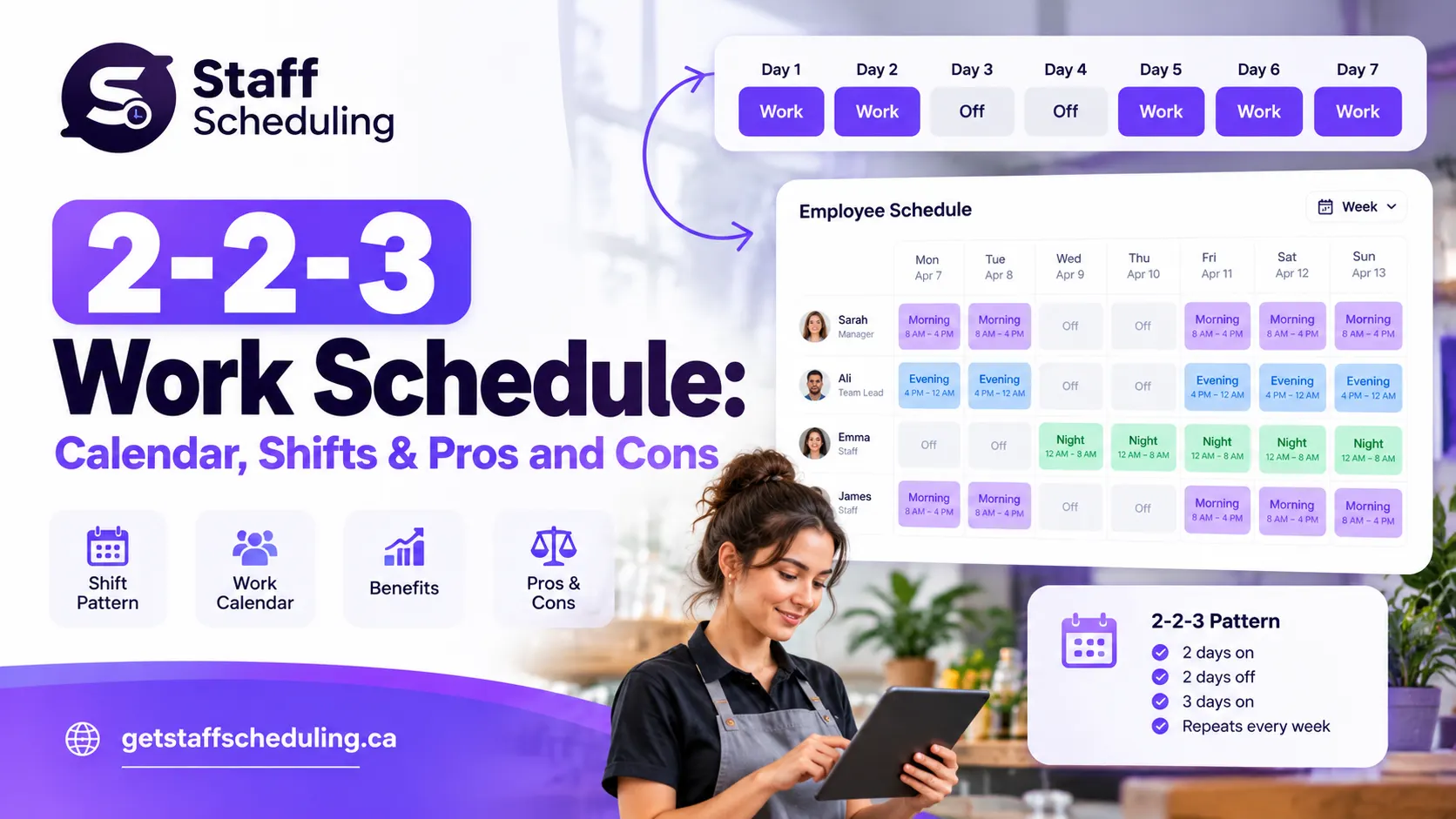
A 2-2-3 work schedule is a rotating shift pattern in which employees work two days, take two days off, work three days, then take two days off, work two days, and take three days off. This 2-2-3 shift schedule repeats every 14 days, giving employees a predictable routine with regular days off and every other weekend free. Many workplaces use 12-hour shifts to maintain 24/7 coverage, but shift lengths and team rotations can vary depending on business needs.
What Is a 2-2-3 Work Schedule?
A 2-2-3 work schedule is a recurring roster that organizes working days and rest periods across a 14-day cycle. Employees work two days, take two days off, work three days, then take two days off, work two days, and finish with three days off. Also known as a 223 schedule or 2/2/3 schedule, this arrangement creates a predictable routine while distributing work and personal time throughout the fortnight.
This 2-2-3 shift pattern can suit industries that need reliable staffing across different shifts. For example, healthcare scheduling and security guard scheduling may involve overnight duties and continuous coverage. Restaurant scheduling and retail scheduling often focus on matching staff availability with busy periods, while cleaning service scheduling may require coordinating teams across multiple sites. The 2-2-3 pattern may also form part of a Panama schedule, but rotation structures, shift lengths, and team arrangements can vary.
How Does a 2-2-3 Rotating Schedule Work?
A 2-2-3 rotating schedule divides work and rest days into a repeating 14-day pattern. Employees follow a set sequence instead of working the same number of days every week. This arrangement helps businesses plan staffing in advance while giving team members a predictable routine.
The 2-2-3 Shift Pattern Explained
The 2-2-3 shift pattern follows six consecutive blocks across two weeks:
Work for two days.
Take two days off.
Work for three days.
Take two days off.
Work for two days.
Take three days off.
This 2-2-3 shift schedule includes seven working days and seven rest days in each complete cycle. Shift lengths depend on the employer, although 12-hour shifts are common in round-the-clock operations.
How the Two-Week Rotation Repeats
After the first 14 days, the same work-and-rest sequence begins again. The basic pattern does not automatically change between day and night duties. Some employers use a separate 28-day rotation to coordinate shift changes across teams. Employees assigned to evening or overnight duties should also understand their scheduled hours. See our guides to second-shift hours and night-shift hours for more details.
2-2-3 Work Schedule Example: A Two-Week Calendar
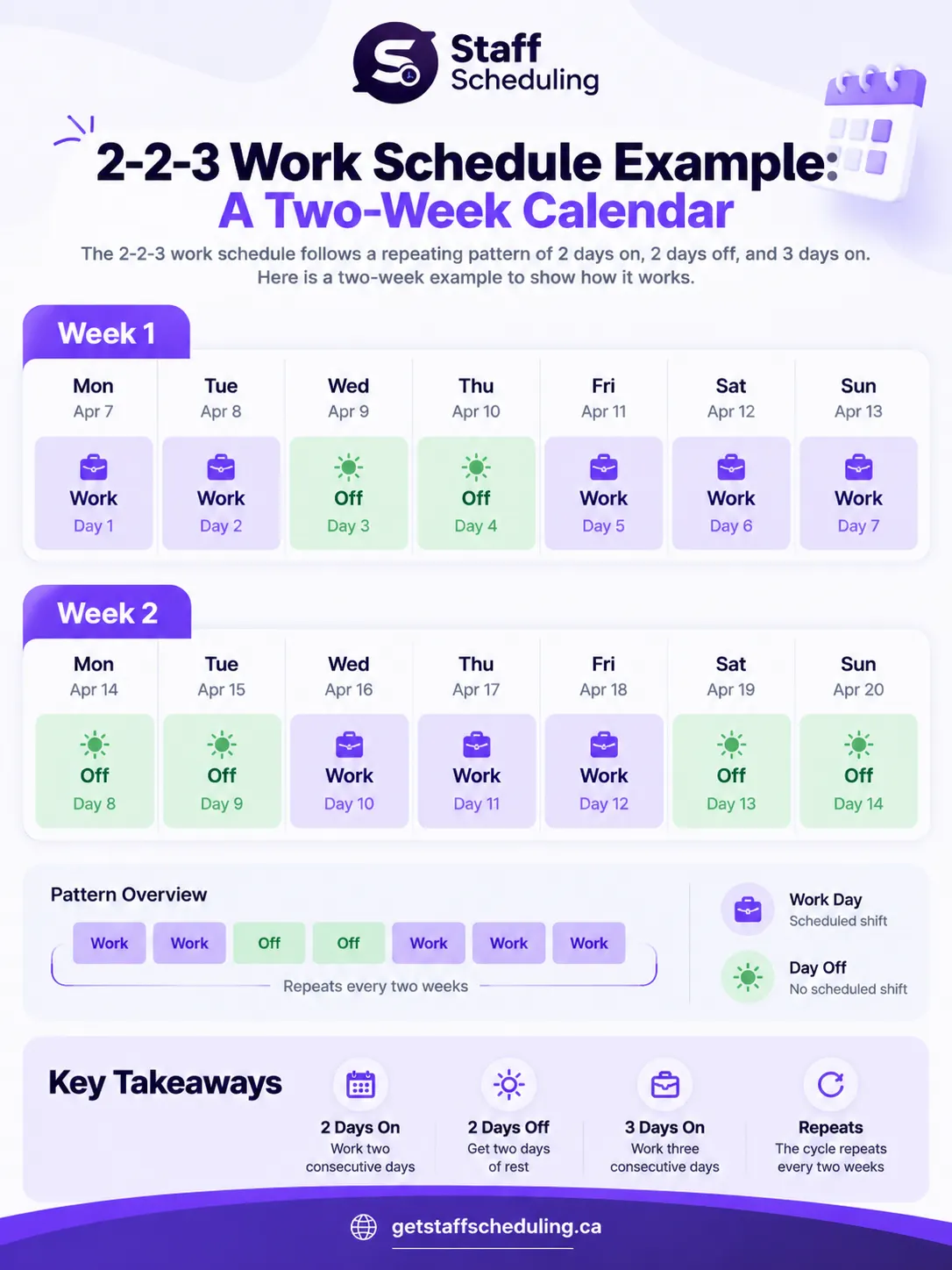
A 2-2-3 work schedule example makes it easier to see how working days and rest periods fit into a regular routine. The calendar below shows one employee's schedule across two weeks, starting on Monday. It follows the standard 2-2-3 pattern and can help managers understand how recurring shifts are organized.
Sample 2-2-3 Work Schedule Calendar
Day
Week 1
Week 2
Monday
Work
Off
Tuesday
Work
Off
Wednesday
Off
Work
Thursday
Off
Work
Friday
Work
Off
Saturday
Work
Off
Sunday
Work
Off
In this 2-2-3 work schedule calendar, the employee works five days in Week 1 and two days in Week 2, giving them seven working days and seven days off across the full cycle. The pattern then repeats. Actual shift times depend on the employer, and this example shows only one employee's workdays, not a complete roster for multiple teams providing round-the-clock coverage.
If you are planning shifts for your own team, our guides on what staff scheduling means and how to make a staff schedule explain the broader planning process.
How to Read and Repeat the Calendar
Use W to mark a workday and O for a day off when creating a 2-2-3 schedule example. Follow the calendar from Monday through Sunday, then continue into the second week to complete the 14-day cycle. Once all 14 days are finished, repeat the same sequence for the next rotation. In a rotating work schedule, the work/off pattern may stay consistent even when different teams have different start dates or shift times. Always check the published 2-2-3 shift schedule for exact start and end times, assigned duties, and any approved changes. This helps employees avoid confusion about overnight shifts, shift swaps, and upcoming days off.
2-2-3 Work Schedule With 12-Hour Shifts: Hours and Overtime
A 2-2-3 work schedule with 12-hour shifts typically gives employees seven shifts during each 14-day cycle. That equals 84 scheduled hours over two weeks, or an average of 42 hours per week. However, actual weekly totals vary depending on how the rotation falls on the calendar. Understanding these hours helps employees plan their time and helps managers organize staffing and payroll.
How Many Hours Do You Work on a 2-2-3 Schedule?
With 12-hour rotating shifts, seven workdays multiplied by 12 hours equals 84 hours per cycle. Dividing that total by two gives an average of 42 hours per week. These figures represent scheduled hours before any unpaid breaks or other adjustments. For a broader overview of shift arrangements, see our guide to work shift schedules.
How Many Days Do You Work Per Week and Month?
In the standard pattern, one calendar week may contain five shifts, or 60 hours, while the next has two shifts, or 24 hours. Across the full cycle, employees work seven days and rest for seven. Monthly totals vary with the calendar and rotation dates, so there is no single monthly figure that applies to every employee. Shift timing also matters: our guides explain mid-shift meaning and evening shift hours.
Does a 2-2-3 Schedule Require Overtime Pay?
Overtime depends on local employment laws, the employer's defined workweek, applicable agreements, and how working hours are counted. An average of 42 hours per week does not automatically mean the same overtime entitlement everywhere. Employers should check the rules that apply to their location before calculating overtime or finalizing payroll.
How to Set Up a 2-2-3 Schedule for 24/7 Shift Coverage
Businesses that operate around the clock need enough employees to cover every shift without leaving gaps in service. A 2-2-3 schedule can help organize working days and rest periods, but managers must also plan team sizes, shift times, and handovers. The right setup depends on the workplace and its staffing needs.
How Four Teams Cover Day and Night Shifts
A four-team shift rotation can divide employees into separate groups to maintain 24/7 shift coverage. For example, two teams may cover day shifts while the other two handle night shifts. Each group follows an assigned work-and-rest pattern, with staggered start dates helping maintain coverage throughout the week.
The 2-2-3 pattern determines when employees work and take time off. The wider team rotation determines how those shifts are distributed across the operation.
Fixed Shifts vs. Rotating Day and Night Shifts
With fixed shifts, employees consistently work days or nights. This makes routines easier to plan, although night coverage may be harder to staff.
A 2-2-3 rotating schedule may also include a planned day/night shift rotation. Employees change between shifts according to an established roster. This can distribute less desirable hours across the team, but frequent changes may affect sleep and recovery. Managers should plan rotations carefully and give employees clear notice of upcoming changes.
2-2-3 Work Schedule vs. Other Shift Patterns
The best rotating shift pattern depends on how many consecutive days employees work, how rest days are distributed, and how much coverage the business needs. Here is how a 2-2-3 schedule compares with other common arrangements.
Shift Pattern
Work/Off Pattern
Typical Shift Length
Main Trade-Off
2-2-3
Two on, two off, three on, followed by two off, two on, three off
Often 12 hours
Regular rest periods, but uneven weekly hours
4-on, 4-off
Four consecutive workdays followed by four days off
Often 10–12 hours
Longer breaks between work blocks, but several consecutive long shifts
2-2-2
Two days on, two days off, then two days on; the rotation depends on the roster
Often 8–12 hours
Frequent changes between work and rest periods
3-2-2-3
Three days on, two off, two on, three off
Varies by employer
Different work blocks and rest-day distribution
2-2-3 vs. 4-on, 4-off Schedule
The 2-2-3 vs. 4-on, 4-off comparison comes down to work blocks and recovery time. The former spreads work across a two-week cycle, while the latter provides four consecutive days off after four working days. Weekly hours depend on shift length and the rotation.
2-2-3 vs. 2-2-2 Schedule
A 2-2-2 shift schedule follows a different sequence from the standard 2-2-3 pattern. Employers should define the exact rotation before comparing rest days or staffing requirements.
3-2-2-3 vs. 2-2-3 Work Schedule
A 3-2-2-3 schedule is a separate pattern, not another name for a 2-2-3 schedule. Compare the actual roster, shift duration, and coverage needs before choosing either option.
Is the 2-2-3 Schedule Right for Your Business?
A 2-2-3 work schedule may suit businesses that need predictable staffing across long operating hours or around-the-clock shifts. Before adopting this 2-2-3 shift pattern, consider these factors:
Staffing demand: Make sure enough employees are available to cover every shift.
Shift length: Check whether your team can manage 10- or 12-hour shifts safely.
Employee preferences: Consider family commitments, preferred working hours, and rest days.
Fatigue management: Allow adequate recovery time, especially for overnight duties.
Payroll requirements: Review overtime rules and how scheduled hours are calculated.
This arrangement works best when the roster meets operational needs without placing unnecessary pressure on employees. If your business does not require continuous coverage, a simpler schedule may be easier to manage.
How to Manage a 2-2-3 Shift Schedule More Easily
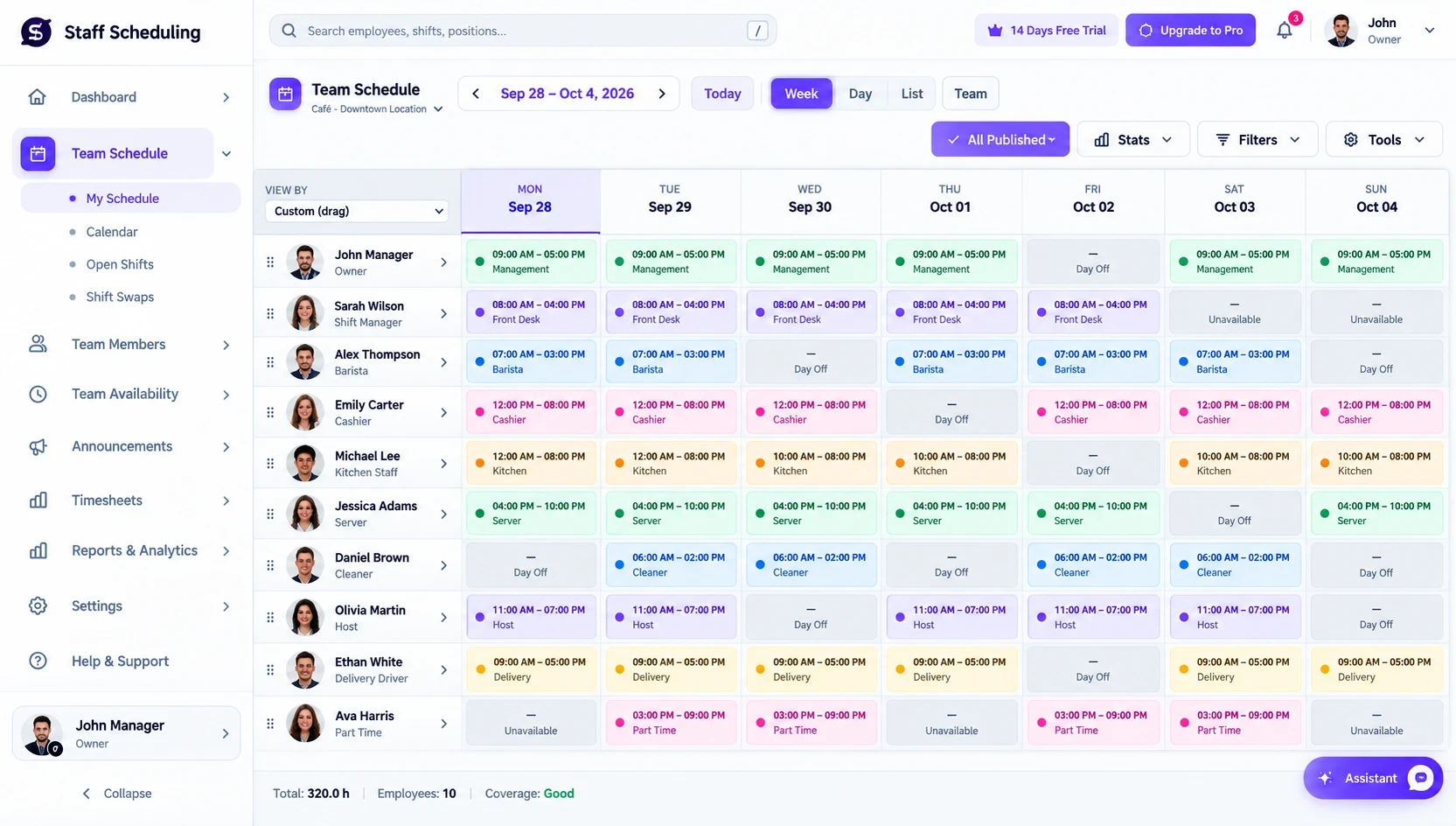
Managing a 2-2-3 schedule becomes easier when recurring shifts and employee availability are organized in one place. Use these practices to keep your roster accurate:
Plan recurring shifts: Set up the 14-day rotation so workdays and rest days follow a consistent pattern.
Check employee availability: Review preferred hours and existing commitments before assigning shifts.
Manage time-off requests: Approve leave early where possible to reduce last-minute scheduling problems.
Coordinate shift swaps: Make sure replacements are approved and qualified for the role.
Identify uncovered shifts: Review the roster before publishing it and arrange backup coverage where needed.
A 2-2-3 schedule template can help you start, while shift scheduling software Scheduling can help organize employee schedules, track availability, and manage shift changes as your team grows.
Frequently Asked Questions About the 2-2-3 Work Schedule
A 2-2-3 schedule is commonly associated with the Panama schedule, a rotating shift system used in some 24/7 workplaces. However, the terms are not always interchangeable because team rotations and day/night shift changes can differ. Check the complete roster to confirm which pattern your workplace follows.
No. Twelve-hour shifts are common in 2-2-3 schedules, especially in round-the-clock operations, but the numbers describe the work-and-rest pattern rather than shift length. Employers may use different shift durations depending on staffing needs and applicable employment rules.
The phrase may describe a longer written sequence or a specific workplace rotation. It is not a universally defined alternative name for the standard 2-2-3 pattern. Check the actual work-and-off calendar to understand the sequence, shift length, and rotation period.
A 2-2-3 schedule follows a two-day, two-day-off, three-day work pattern across a repeating 14-day cycle. A 3-2-2-3 schedule uses a different sequence of working and rest days. Comparing calendar examples makes the differences easier to identify.
Yes. Excel can display dates, assigned shifts, working days, days off, and employee names. You can create a repeating 14-day calendar and adapt it for different teams. Review formulas and shift assignments before sharing the final roster.
No single rule applies everywhere. Legal requirements for working hours, overtime, breaks, and rest periods depend on the applicable jurisdiction and employment agreements. Employers should check local labour laws before implementing the schedule.
About Staff Scheduling
Staff Scheduling is a leading workforce management platform empowering thousands of businesses across healthcare, retail, and hospitality to optimize labor costs, reduce scheduling errors, and enhance team communication through smart, automated scheduling tools.
Share This Article
Get News First
Official press releases and product updates delivered directly to your inbox.