Hey there! Welcome to the world of business. Have you ever heard terms like ROI, profit margin, revenue, or SWOT analysis and wondered what they mean? If yes, you’re not alone.
The business world has its own language. Some business terms may sound confusing at first, especially if you’re new to business. But you don’t need a business degree to understand them.
Learning common business terminology and business vocabulary can make things much easier. It can help you understand meetings, emails, reports, and everyday workplace conversations.
In this guide, we’ll explain basic and advanced business terms in simple language. You’ll find clear definitions, easy examples, and useful business English vocabulary that you can use in real-life situations.
What Are Business Terms?
Business terms are words and phrases that people commonly use when talking about business. They can describe money, sales, marketing, employees, management, customers, and many other parts of a business.
For example, revenue means the money a business earns from selling its products or services. Profit is the money left after the business pays its costs. These are simple examples of business terms you may hear often.
What Is Business Terminology?
Business terminology is the collection of words and phrases used in the business world. It includes terms used in areas such as finance, marketing, sales, accounting, management, and operations.
In simple words, business terminology is the language professionals use to talk about how a business works.
Business Terms vs. Business Vocabulary
These two phrases are closely related, but they are not exactly the same.
Business terms usually refer to specific words or phrases with a particular meaning in business. For example, cash flow, target market, and profit margin are business terms.
Business vocabulary is a broader group of words used when speaking or writing about business. It can include specific business terms as well as common words used in professional communication.
What Is Business Language?
Business language is the way people communicate in professional and business settings. It includes the words, phrases, and expressions used in meetings, emails, reports, presentations, and conversations.
Using the right business language can make communication clearer and more professional.
How Are Business Terms Used?
You can find business terms in many everyday situations. They are used in company meetings, financial reports, marketing plans, sales discussions, job interviews, and business emails.
For example, a manager may talk about revenue growth, while a marketing team may discuss the target market. Learning these terms helps you understand what people are talking about and communicate more confidently.
Why Is Business Terminology Important?

Understanding business terminology can make professional life much easier. You don’t need to know every business word, but knowing common terms helps you communicate clearly and understand what others are saying.
Professional Communication
Business terms help you explain your ideas in a clear and professional way. They can also make it easier to talk with clients, managers, coworkers, and business partners.
Workplace Conversations
Many workplace conversations include common business terms. Knowing their meaning helps you follow discussions without feeling lost or confused.
Business Emails
Business emails often use specific words and phrases. Understanding business vocabulary can help you read emails faster and write clear, professional replies.
Meetings and Presentations
Meetings and presentations often include terms related to goals, sales, performance, budgets, and results. Knowing these terms helps you understand the discussion and share your ideas with confidence.
Business Decision-Making
Business terminology is also useful when making decisions. Terms related to costs, revenue, profit, sales, and performance can help you understand important business information before choosing what to do next.
Supports Career Development
Good knowledge of business terminology can be useful in many careers. It can help you communicate with managers, coworkers, clients, and other professionals.
Improves Your Business English
Learning business terms is also a simple way to improve your business English. The more useful terms you understand, the easier it becomes to communicate in professional situations.
Common Business Terms Every Beginner Should Know
If you’re new in the business world, You may hear many words that sound confusing at first. Don’t worry. You only need to understand the most common ones first.
Here are some important business terms that beginners should know.
Business
A business sells products or services to customers to make money.
Example: A restaurant is a business that sells food and drinks.
Business Model
A business model explains how a business makes money.
Example: A software company may charge customers a monthly subscription fee.
Business Plan
A business plan explains what a business does and how it plans to grow.
Example: A new business may create a plan for its products, customers, costs, and goals.
Revenue
Revenue is the total money a business earns from selling its products or services.
Example: If a shop makes $10,000 in sales, its revenue is $10,000.
Profit
Profit is the money left after a business pays its costs and expenses.
Example: If a business earns $10,000 and spends $7,000, its profit is $3,000.
Loss
A loss happens when a business spends more money than it earns.
Example: If a company earns $5,000 but spends $6,000, it has a $1,000 loss.
Cost
A cost is the money needed to produce a product or provide a service.
Example: A bakery may spend money on flour, packaging, and equipment.
Expense
An expense is money a business spends to keep running.
Example: Rent, salaries, electricity, and office supplies are common expenses.
Customer
A customer is someone who buys a product or service.
Example: A person buying shoes from a store is a customer.
Client
A client is a person or business that pays for professional services.
Example: A company hiring an SEO agency is a client.
Market
A market is a group of people or businesses interested in a product or service.
Example: The online learning market includes students and professionals.
Competitor
A competitor is another business that offers similar products or services.
Example: Two coffee shops in the same area can be competitors.
Target Market
A target market is the specific group of customers a business wants to reach.
Example: A school supplies company may target students, parents, and teachers.
Stakeholder
A stakeholder is a person or group that has an interest in a business.
Example: Employees, customers, owners, and investors can all be stakeholders.
Business Strategy
A business strategy is a plan for reaching business goals.
Example: A company may offer better prices or improve customer service to attract more customers.
Startup
A startup is a new business that is usually built around a product, service, or idea.
Example: A new company creating an AI tool can be called a startup.
Entrepreneur
An entrepreneur is a person who starts and runs a business.
Example: Someone who starts and manages an online store is an entrepreneur.
Small and Medium-Sized Enterprise (SME)
A Small and Medium-Sized Enterprise (SME) is a small or medium-sized business.
Example: A local restaurant or small marketing agency can be an SME.
Key Performance Indicator (KPI)
A Key Performance Indicator (KPI) is a number used to measure business performance.
Example: Sales, website traffic, and customer retention can be KPIs.
Return on Investment (ROI)
Return on Investment (ROI) shows how much money you gain or lose from an investment.
Example: If you spend $1,000 on advertising and make $1,500 from it, the investment has a positive ROI.
Break-Even Point
The break-even point is when a business earns enough money to cover its costs.
At this point, the business has neither a profit nor a loss.
Example: If a business needs $5,000 in sales to cover its costs, $5,000 is its break-even point.
Cash Flow
Cash flow is the money coming into and going out of a business.
Example: Customer payments bring money in, while rent and salaries take money out.
Working Capital
Working capital is the money a business has for its daily and short-term needs.
Example: A business may use working capital to pay suppliers, salaries, and bills.
Business Terms for Strategy and Operations
Once you understand the basic business terms, it helps to learn the words used in strategy and daily operations. These terms explain how businesses set goals, manage work, handle risks, and grow.
Business Strategy
A business strategy is a plan a company uses to reach its goals and grow.
Example: A company may focus on better prices and customer service to attract more customers.
Business Goals
Business goals are the results a company wants to achieve.
Example: A business may set a goal to increase its sales by 20% this year.
Business Objectives
Business objectives are specific steps or targets that help a business reach its goals.
Example: A company may aim to get 500 new customers in the next six months.
Business Operations
Business operations are the daily activities that keep a business running.
Example: Taking orders, managing employees, serving customers, and delivering products are business operations.
Business Process
A business process is a set of steps used to complete a task.
Example: An online store may have a process for receiving an order, packing it, and sending it to the customer.
Competitive Advantage
A competitive advantage is something that helps a business perform better than its competitors.
Example: Lower prices, better quality, or faster service can give a company a competitive advantage.
Benchmarking
Benchmarking means comparing your business performance with other businesses or industry standards.
Example: A company may compare its customer service results with leading companies in its industry.
SWOT Analysis
A SWOT analysis (Strengths Weaknesses Opportunities Threats) is a simple tool used to understand a business’s strengths, weaknesses, opportunities, and threats.
Example: A company may use SWOT analysis before launching a new product.
Critical Success Factor
A critical success factor is something that is essential for a business to achieve its goals.
Example: Fast delivery may be a critical success factor for an online shopping business.
Key Performance Indicator
A Key Performance Indicator (KPI) is a number used to measure how well a business or team is performing.
Example: Sales, customer retention, and website traffic can all be KPIs.
Economies of Scale
Economies of scale happen when a business reduces its average cost by producing more products or services.
Example: A factory may lower its cost per product when it produces goods in larger quantities.
Diversification
Diversification means adding new products, services, or markets to reduce dependence on one area.
Example: A clothing company may start selling shoes and accessories as well.
Risk Management
Risk management means finding possible business risks and taking steps to reduce them.
Example: A company may have backup suppliers in case its main supplier cannot deliver products.
Scalability
Scalability is the ability of a business to grow without its costs increasing at the same rate.
Example: A software company can serve more customers without opening a new physical location.
Supply Chain
A supply chain is the network involved in making and delivering a product to customers.
Example: A clothing supply chain may include suppliers, manufacturers, warehouses, and delivery companies.
Exit Strategy
An exit strategy is a plan for how a business owner may leave or sell the business in the future.
Example: An owner may plan to sell the company to another business after it reaches a certain size.
Finance and Accounting Business Terms
Finance and accounting use many common business terms. Understanding them can help you better understand money, financial reports, costs, and business performance.
Here are some important business terms used in finance and accounting.
Accounts
Accounts are records of a business’s financial activities. They include information about income, expenses, assets, and other financial transactions.
Example: A business keeps accounts to track its sales and expenses.
Accounting Period
An accounting period is a specific period used to record and report financial activity.
Example: A business may prepare its accounts every month, quarter, or year.
Accounts Payable
Accounts payable is money a business owes to its suppliers or other businesses.
Example: If a company buys supplies on credit, the amount it owes becomes accounts payable.
Accounts Receivable
Accounts receivable is money that customers owe to a business.
Example: If a customer buys a product on credit, the unpaid amount is accounts receivable.
Assets
Assets are things a business owns that have value.
Example: Cash, equipment, property, and inventory can be business assets.
Liabilities
Liabilities are debts or financial obligations a business needs to pay.
Example: Loans, unpaid bills, and accounts payable are liabilities.
Equity
Equity is the value that belongs to the owners after business liabilities are deducted from its assets.
Example: If a business has $100,000 in assets and $40,000 in liabilities, its equity is $60,000.
Balance Sheet
A balance sheet shows a business’s assets, liabilities, and equity at a specific point in time.
Example: A company may prepare a balance sheet at the end of each year.
Income Statement
An income statement shows a business’s revenue, expenses, and profit or loss over a specific period.
Example: A company can use an income statement to see how much it earned and spent during a month.
Profit and Loss Statement
A profit and loss statement (P&L) is another name for an income statement. It shows whether a business made a profit or a loss during a specific period.
Revenue
Revenue is the money a business earns from selling products or services.
Example: If a store makes $20,000 from sales, its revenue is $20,000.
Gross Profit
Gross profit is the money left after subtracting the direct cost of producing or buying products from revenue.
Example: If revenue is $20,000 and the cost of products is $12,000, gross profit is $8,000.
Net Profit
Net profit is the money left after all business expenses have been paid.
Example: A business may have $8,000 in gross profit but $5,000 in net profit after other expenses.
Profit Margin
Profit margin shows how much of a business’s revenue becomes profit. It is usually shown as a percentage.
Example: A 20% profit margin means the business keeps $20 as profit for every $100 in revenue.
Cash Flow
Cash flow is the money coming into and going out of a business.
Example: Customer payments bring cash in, while rent and supplier payments take cash out.
Working Capital
Working capital is the money available for a business to handle its short-term needs.
Example: A company may use working capital to pay salaries, suppliers, and regular bills.
Capital
Capital is money or other resources used to start, run, or grow a business.
Example: An owner may invest $50,000 as capital to start a new business.
Capital Expenditure (CAPEX)
Capital expenditure (CAPEX) is money spent on long-term assets.
Example: Buying property, machinery, or major equipment can be CAPEX.
Operating Expenditure (OPEX)
Operating expenditure (OPEX) is money spent on the day-to-day running of a business.
Example: Rent, salaries, utilities, and office expenses are common OPEX.
Fixed Costs
Fixed costs stay mostly the same even when sales or production change.
Example: Monthly rent is usually a fixed cost.
Variable Costs
Variable costs change as production or sales change.
Example: The cost of raw materials may increase when a business produces more products.
Overheads
Overheads are regular business costs that are not directly linked to making a specific product or service.
Example: Office rent, electricity, and administration costs can be overheads.
Depreciation
Depreciation is the gradual reduction in the recorded value of a long-term asset over time.
Example: A company’s equipment may lose value as it gets older and is used.
Fiscal Year
A fiscal year is a 12-month period used by a business or organization for financial reporting.
Example: A company may use a fiscal year that runs from July to June.
Invoice
An invoice is a document that tells a customer how much they need to pay for products or services.
Example: A freelancer sends an invoice after completing work for a client.
Creditor
A creditor is a person or business that is owed money.
Example: A supplier can be a creditor if a company has not yet paid its bill.
Debtor
A debtor is a person or business that owes money to another party.
Example: A customer who has not paid an invoice is a debtor.
Collateral
Collateral is an asset used as security for a loan.
Example: A business may use property as collateral when applying for a loan.
Liquidity
Liquidity refers to how easily an asset can be turned into cash without losing much value.
Example: Cash has high liquidity because it can be used immediately.
Liquid Assets
Liquid assets are assets that can be quickly converted into cash.
Example: Cash and some short-term investments are liquid assets.
Dividend
A dividend is a payment a company may give to its shareholders from its profits.
Example: A company may pay shareholders a dividend once or several times a year.
Interest Rate
An interest rate is the percentage charged on borrowed money or earned on savings or investments.
Example: A bank may charge a 6% annual interest rate on a business loan.
Present Value
Present value is the current value of money that will be received or paid in the future.
Example: $1,000 received next year is worth less today because money can earn interest over time.
Rate of Return
Rate of return shows how much an investment has gained or lost compared with the amount invested.
Example: If you invest $1,000 and earn $100, your rate of return is 10%.
Return on Investment (ROI)
Return on Investment (ROI) measures the gain or loss from an investment compared with its cost.
Example: If a business spends $1,000 on marketing and earns $1,200 in profit from it, the campaign has a positive ROI.
Yield
Yield is the income an investment generates, usually shown as a percentage of its value.
Example: An investment that pays $50 each year on a $1,000 investment has a 5% yield.
Enterprise Value
Enterprise value (EV) is a measure of the total value of a company. It considers the company’s market value along with its debt and cash.
Example: Investors may use enterprise value when comparing the value of different companies.
Sales and Marketing Business Terms
Sales and marketing have their own set of business terms. You’ll often see these words in sales calls, marketing plans, ads, and customer reports.
Here are some common terms explained in simple language.
Sales
Sales is the process of selling a product or service to a customer.
Example: A salesperson talks to a customer and helps them choose a product.
Lead
A lead is a person or business that has shown some interest in a product or service.
Example: Someone who fills out a contact form on a website can be a lead.
Prospect
A prospect is a potential customer who may be a good fit for what a business offers.
Example: A company looking for new software can be a prospect for a software provider.
Qualified Lead
A qualified lead is a lead that meets certain conditions and is more likely to become a customer.
Example: A person who needs your service, has the budget, and is ready to buy may be a qualified lead.
Sales Funnel
A sales funnel shows the steps a person takes before becoming a customer.
Example: A person may discover a brand, visit its website, compare products, and then make a purchase.
Sales Pipeline
A sales pipeline shows the sales opportunities a business is currently working on.
Example: A sales team may have leads at different stages, such as contacted, interested, negotiating, and ready to buy.
Conversion Rate
Conversion rate is the percentage of people who complete a desired action.
Example: If 100 people visit a landing page and 5 sign up, the conversion rate is 5%.
Customer Acquisition
Customer acquisition is the process of getting new customers.
Example: A business may use ads, SEO, social media, or email marketing to attract new customers.
Customer Retention
Customer retention means keeping existing customers and encouraging them to continue buying from your business.
Example: Good customer support can help a company retain more customers.
Customer Acquisition Cost (CAC)
Customer Acquisition Cost (CAC) is the average amount a business spends to get one new customer.
Example: If a company spends $1,000 on marketing and gets 20 new customers, its CAC is $50.
Customer Lifetime Value (CLV)
Customer Lifetime Value (CLV) is the estimated amount of money a customer may spend with a business over time.
Example: A customer who spends $50 every month for two years has a higher CLV than a one-time buyer.
Target Market
A target market is the specific group of customers a business wants to reach.
Example: A fitness brand may target people who are interested in health and exercise.
Market Segmentation
Market segmentation means dividing a large market into smaller groups based on things like age, location, interests, or buying habits.
Example: A clothing brand may create different campaigns for teenagers and adults.
Market Share
Market share is the percentage of total sales in a market that belongs to a particular company.
Example: If a company makes 20% of all sales in its market, it has a 20% market share.
Marketing Mix
The marketing mix is a group of elements a business uses to market its products or services. A common model includes the 4 Ps: Product, Price, Place, and Promotion.
Example: A company may change its price or promotion to attract more customers.
Value Proposition
A value proposition explains why customers should choose a product or service.
Example: A software company may promise to help businesses save time and reduce costs.
Brand Awareness
Brand awareness means how familiar people are with a brand.
Example: If customers recognize a company’s name or logo, it has strong brand awareness.
Brand Equity
Brand equity is the value a brand gains from its reputation and how customers see it.
Example: People may be willing to pay more for a trusted brand because they know and value it.
Affiliate Marketing
Affiliate marketing is a method where people or businesses promote another company’s products and earn a commission from sales or other actions.
Example: A blogger may recommend a product using a special affiliate link.
B2B (Business-to-Business)
B2B means Business-to-Business. It describes businesses that sell products or services to other businesses.
Example: A software company selling scheduling tools to restaurants is a B2B business.
B2C (Business-to-Consumer)
B2C means Business-to-Consumer. It describes businesses that sell directly to individual customers.
Example: An online clothing store selling clothes directly to shoppers is B2C.
Call to Action (CTA)
A Call to Action (CTA) is a message that tells people what to do next.
Example: Buttons like “Buy Now,” “Sign Up,” or “Get a Free Trial” are CTAs.
Return on Ad Spend (ROAS)
Return on Ad Spend (ROAS) measures how much revenue a business earns from its advertising spend.
Example: If a company spends $500 on ads and earns $2,000 in revenue, its ROAS is 4:1.
Human Resources and Workplace Business Terms
Every workplace has its own business terms. HR and workplace terms are used when talking about employees, hiring, salaries, management, and company culture.
Here are some common terms explained in simple words.
Human Resources (HR)
Human Resources (HR) is the department that manages employee-related matters in a company.
Example: HR may handle hiring, employee records, benefits, and workplace policies.
Recruitment
Recruitment is the process of finding people for job openings.
Example: A company may post a job ad and interview candidates as part of recruitment.
Hiring
Hiring is the process of choosing and employing someone for a job.
Example: After interviews, a company may hire the candidate who is the best fit.
Onboarding
Onboarding is the process of helping a new employee get started in a company.
Example: Onboarding may include training, setting up accounts, and introducing the new employee to the team.
Employee Retention
Employee retention means keeping employees in a company for a longer time.
Example: Good pay, support, and a positive workplace can help improve employee retention.
Employee Engagement
Employee engagement shows how connected and involved employees feel in their work.
Example: Employees who enjoy their work and take an active interest in company goals often have high engagement.
Workforce
A workforce is the group of people who work for a company or organization.
Example: A company with 100 employees has a workforce of 100 people.
Job Description
A job description explains what a job involves and what the employer expects from the person in that role. It usually includes the main duties, required skills, working hours, and responsibilities for a specific position.
For example, if you are hiring restaurant staff, a server job description can outline the duties and expectations of a server. Similarly, a cashier job description can explain the responsibilities and skills needed for a cashier role.
Example: A server job description may list duties, skills, working hours, and responsibilities.
Performance Review
A performance review is a meeting or process used to check an employee’s work and progress.
Example: A manager may review an employee’s performance every six months.
Compensation
Compensation is the money and other rewards an employee receives for their work.
Example: Salary, bonuses, and certain benefits can be part of compensation.
Employee Benefits
Employee benefits are extra benefits employees receive in addition to their regular pay.
Example: Health coverage, paid time off, and retirement plans can be employee benefits.
Payroll
Payroll is the process of paying employees and keeping records of their wages and deductions.
Example: A company processes payroll every two weeks or once a month.
Full-Time Equivalent (FTE)
Full-Time Equivalent (FTE) is a way to measure employees based on full-time working hours.
Example: Two employees who each work half-time may equal 1 FTE.
Contractor
A contractor is a person who provides services to a business but is not usually a permanent employee.
Example: A company may hire a contractor to design its website for a specific project.
Organizational Culture
Organizational culture is the way people work and interact within a company.
Example: A company that values teamwork, honesty, and open communication has a strong workplace culture.
Work-Life Balance
Work-life balance means having enough time for both work and personal life.
Example: Flexible working hours can help employees maintain a better work-life balance.
Management
Management is the process of planning work, organizing teams, and making sure business tasks are completed.
Example: A manager may assign tasks, support employees, and track team performance.
Leadership
Leadership is the ability to guide and motivate people toward a common goal.
Example: A good leader helps the team stay focused and supports employees when they face challenges.
Technology and Digital Business Terms
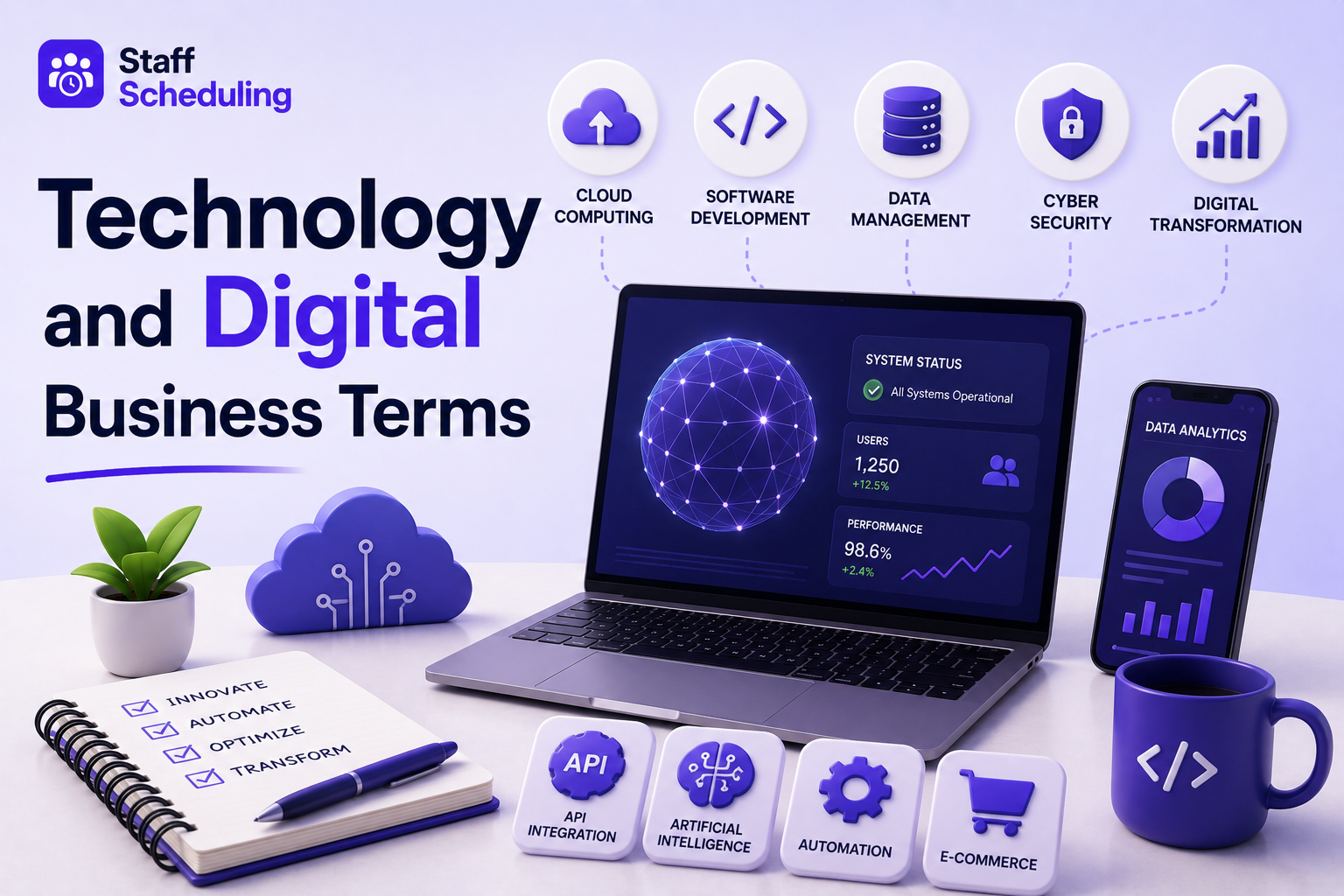
Technology is now a big part of modern business. You may come across these business terms when talking about websites, software, data, online sales, and digital tools.
Here are some common technology terms explained in simple words.
Software as a Service (SaaS)
Software as a Service (SaaS) is software that people use online instead of installing it on their own computer.
Example: Online tools for scheduling, accounting, or project management can be SaaS products.
E-commerce
E-commerce means buying and selling products or services online.
Example: An online store that sells clothes through a website is an e-commerce business.
Digital Transformation
Digital transformation means using digital technology to improve how a business works.
Example: A company may replace paper records with an online system.
Automation
Automation means using technology to complete tasks with little or no manual work.
Example: An email system can automatically send a welcome message to new customers.
Artificial Intelligence (AI)
Artificial Intelligence (AI) is technology that allows computers to perform tasks that usually need human intelligence.
Example: Businesses may use AI for chatbots, data analysis, or content assistance.
Cloud Computing
Cloud computing means using online servers to store data or run software instead of relying only on your own computer.
Example: Businesses can store files online and access them from different devices.
Business Intelligence (BI)
Business Intelligence (BI) means using data and reports to understand how a business is performing.
Example: A company may use a dashboard to track sales and customer data.
Data Analytics
Data analytics is the process of studying data to find useful information and patterns.
Example: A business can study sales data to see which products are selling the most.
Customer Relationship Management (CRM)
Customer Relationship Management (CRM) is a system used to manage customer information and interactions.
Example: A sales team can use a CRM to track customers, leads, calls, and emails.
Enterprise Resource Planning (ERP)
Enterprise Resource Planning (ERP) is software that helps businesses manage different areas in one system.
Example: An ERP system may manage finance, inventory, purchasing, and employee information.
Application Programming Interface (API)
An Application Programming Interface (API) allows different software systems to communicate with each other.
Example: A website may use an API to connect with a payment or shipping service.
Cybersecurity
Cybersecurity means protecting computers, networks, systems, and business data from digital threats.
Example: Strong passwords and security software can help protect a business from cyber attacks.
Digital Marketing
Digital marketing means promoting products or services through online channels.
Example: SEO, social media, email, and online ads are common forms of digital marketing.
Subscription Model
A subscription model is a business model where customers pay regularly to use a product or service.
Example: A software company may charge customers a monthly or yearly fee.
Business Models and Company Structure Terms
Businesses can have different ownership structures and ways of operating. These business terms help explain who owns a business, how it is funded, and how different companies work together.
Sole Proprietorship
A sole proprietorship is a business owned and run by one person.
Example: A person running their own small photography business may have a sole proprietorship.
Partnership
A partnership is a business owned by two or more people who share the business and its responsibilities.
Example: Two friends who start a consulting business together may form a partnership.
Limited Liability Company (LLC)
A Limited Liability Company (LLC) is a business structure that can protect the owners from being personally responsible for many business debts.
Example: A small business owner may choose an LLC to separate personal and business finances.
Private Limited Company
A private limited company is a company owned by shareholders, but its shares are not normally offered to the general public.
Example: Many privately owned businesses use this structure to operate and grow.
Corporation
A corporation is a legal business entity that is separate from its owners.
Example: A large company may operate as a corporation and have shareholders.
Nonprofit Organization
A nonprofit organization is created mainly to support a social, educational, charitable, or other public purpose rather than to make profits for owners.
Example: A charity that supports education can be a nonprofit organization.
Social Enterprise
A social enterprise is a business that aims to make money while also solving a social or environmental problem.
Example: A company may sell products and use part of its income to support local communities.
Franchise
A franchise is a business that allows another person or company to use its brand and business system for a fee.
Example: A local restaurant may operate under the brand of a larger restaurant chain.
Startup
A startup is a new business built around a product, service, or business idea.
Example: A new technology company creating a mobile app can be a startup.
Bootstrapping
Bootstrapping means starting and growing a business using your own money or money earned by the business.
Example: An entrepreneur may use personal savings to launch a small online store instead of getting outside funding.
Business Angel
A business angel, also called an angel investor, is a person who invests their own money in a new or growing business.
Example: An angel investor may give money to a startup in exchange for a share of the company.
Venture Capital
Venture capital is money invested in startups and growing companies that have strong growth potential.
Example: A venture capital firm may invest millions in a technology startup that is growing quickly.
Merger
A merger happens when two companies join together to form one business.
Example: Two companies may merge to expand their products or reach more customers.
Acquisition
An acquisition happens when one company buys another company.
Example: A large technology company may acquire a smaller software company.
Takeover
A takeover happens when one company gains control of another company, usually by buying enough of its shares.
Example: A larger company may take over a smaller competitor.
Joint Venture
A joint venture is a business arrangement where two or more companies work together on a specific project or goal.
Example: Two companies may create a joint venture to launch a new product.
Subsidiary
A subsidiary is a company that is controlled by another company, known as the parent company.
Example: A large company may own several subsidiaries in different countries.
Affiliate
An affiliate is a company or organization that is connected to another business through ownership, partnership, or another business relationship.
Example: A company may work with an affiliate to promote its products or services.
Legal and Intellectual Property Business Terms
Businesses also deal with laws, agreements, and legal rights. These business terms help you understand how companies protect their work and follow the rules.
Intellectual Property (IP)
Intellectual property (IP) means something original that belongs to a person or business.
Example: A logo, invention, book, or software can be intellectual property.
Copyright
Copyright protects original work from being copied or used without permission.
Example: A company can have copyright over its website content, photos, or videos.
Trademark
A trademark protects a brand name, logo, symbol, or phrase.
Example: A company can trademark its brand name or logo.
Patent
A patent gives an inventor legal rights over a new invention for a certain period.
Example: A company may get a patent for a new machine it creates.
Trade Secret
A trade secret is private business information that gives a company an advantage.
Example: A secret recipe or special business method can be a trade secret.
Contract
A contract is a written or spoken agreement between two or more parties.
Example: A business may sign a contract with a supplier before buying products.
Compliance
Compliance means following the laws and rules that apply to a business.
Example: A company must follow tax, employment, and safety rules.
Liability
Liability means being legally or financially responsible for something.
Example: A business may have liability if its actions cause harm or damage.
Confidentiality
Confidentiality means keeping private information safe and not sharing it without permission.
Example: An employee may need to keep customer information confidential.
Non-Disclosure Agreement (NDA)
A Non-Disclosure Agreement (NDA) is an agreement that keeps certain information private.
Example: A company may ask a partner to sign an NDA before sharing a new business idea.
Due Diligence
Due diligence means checking important information before making a business decision.
Example: Before buying a company, a buyer may check its finances, debts, and contracts.
Audit
An audit is a careful check of a company’s financial records.
Example: An auditor may check a company’s records to make sure the numbers are correct.
Corporate Social Responsibility (CSR)
Corporate Social Responsibility (CSR) means a company tries to have a positive impact on society and the environment.
Example: A company may support a local charity or reduce waste as part of its CSR efforts.
Ethical Business Practices
Ethical business practices mean running a business in an honest and fair way.
Example: A company that treats employees fairly and gives customers honest information follows ethical business practices.
Economics and Global Business Terms
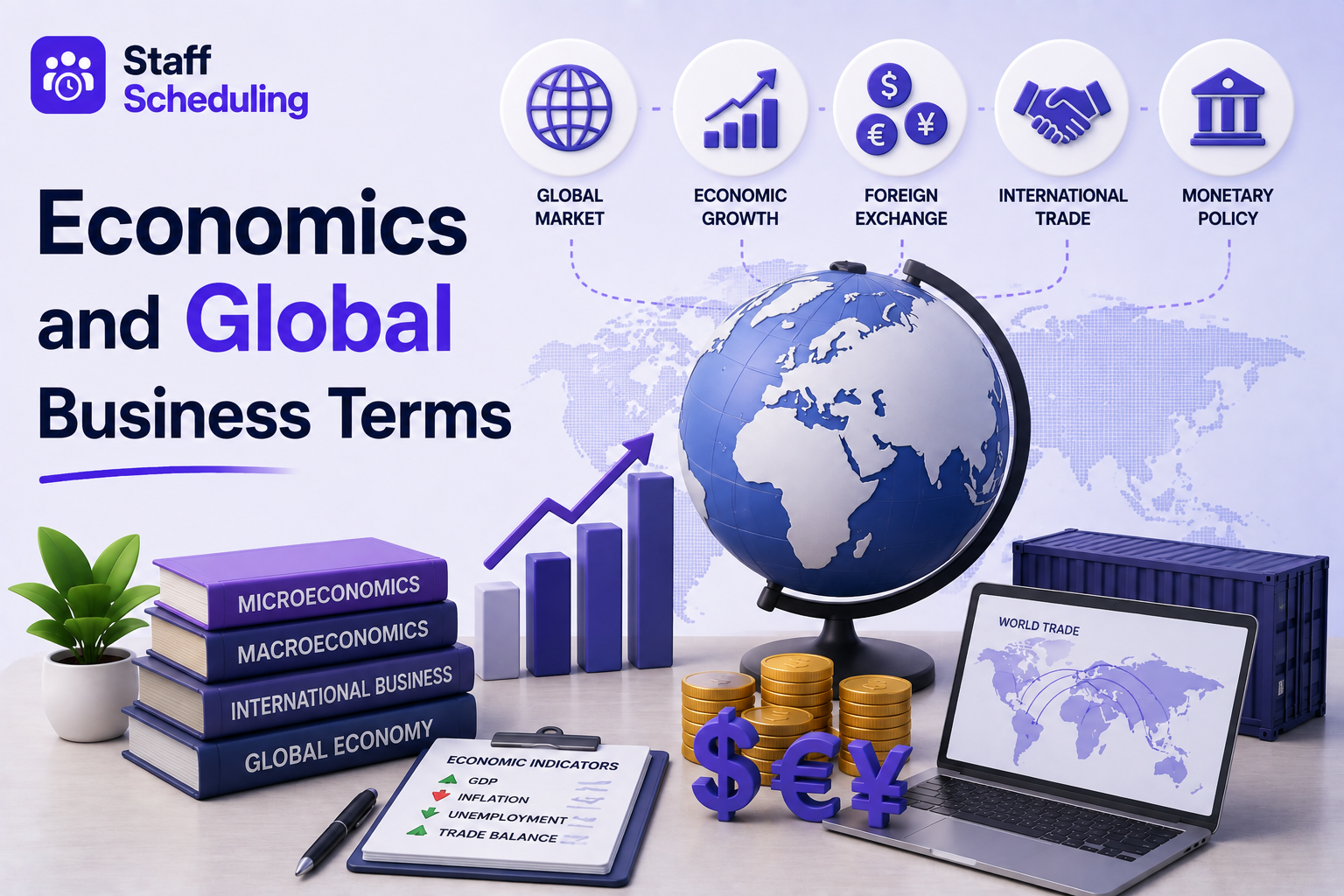
Some business terms are connected to the economy and global trade. You may see these words in business news, reports, and financial discussions.
Here are the most common ones in simple language.
Inflation
Inflation means the prices of goods and services are going up over time.
Example: If a product costs $10 today and $11 next year, the price has increased due to inflation.
Recession
A recession is a period when economic activity slows down for a significant time.
Example: During a recession, businesses may sell less and people may spend less money.
Economic Growth
Economic growth means the economy is producing more goods and services over time.
Example: More businesses, jobs, and production can be signs of economic growth.
Gross Domestic Product (GDP)
Gross Domestic Product (GDP) is the total value of goods and services produced within a country during a specific period.
Example: GDP is often used to see how large and active an economy is.
Gross National Product (GNP)
Gross National Product (GNP) measures the value produced by a country's people and businesses, including income earned from outside the country.
Example: GNP can include income earned by a company from its operations in another country.
Supply and Demand
Supply and demand explain how the amount of a product and customer demand can affect its price.
Example: If demand for a product rises but supply stays low, its price may increase.
Microeconomics
Microeconomics looks at how individuals and businesses make economic decisions.
Example: It can study how a business sets prices or how customers choose products.
Macroeconomics
Macroeconomics looks at the economy as a whole.
Example: It studies topics like inflation, unemployment, and economic growth.
Base Rate
A base rate is a key interest rate set by a central bank. It can affect other interest rates in an economy.
Example: A change in the base rate can affect the cost of business loans.
Hyperinflation
Hyperinflation is an extremely fast rise in prices.
Example: During hyperinflation, the value of money can fall very quickly.
Trade Balance
Trade balance is the difference between a country's exports and imports.
Example: If a country exports more than it imports, it has a trade surplus.
Import
An import is a product or service bought from another country.
Example: A company in Canada buying products from Japan is importing them.
Export
An export is a product or service sold to another country.
Example: A company in Canada selling products to customers in the United States is exporting.
Commodity
A commodity is a basic product that can be bought and sold, often in large quantities.
Example: Oil, gold, wheat, and natural gas are common commodities.
Exchange Rate
An exchange rate shows how much one country's currency is worth compared with another currency.
Example: The exchange rate tells you how many US dollars you can get for a certain amount of Canadian dollars.
Globalization
Globalization means countries and businesses becoming more connected through trade, technology, and investment.
Example: A company may produce its products in one country and sell them around the world.
Industrial Output
Industrial output is the total amount of goods produced by a country's industries.
Example: Higher factory production can lead to higher industrial output.
Investment and Financial Market Business Terms
Investment and financial markets have many terms that may sound difficult at first. But most of them are easy to understand when explained in simple words.
Here are some common business terms used in investing and financial markets.
Bond
A bond is a type of investment where you buy money to a company or government. They pay you interest and return your money later.
Example: You buy a government bond and receive interest over time.
Blue-Chip Stock
A blue-chip stock is a share in a large and well-known company with a strong business history.
Example: Investors may consider shares of large, established companies as blue-chip stocks.
Shareholder
A shareholder is a person or organization that owns shares in a company.
Example: If you own shares in a company, you are a shareholder.
Ordinary Share
An ordinary share gives an investor a small ownership part of a company.
Example: If you buy ordinary shares, you may have voting rights and may receive dividends.
Share Index
A share index tracks the performance of a group of company shares.
Example: A stock market index can show whether a group of shares is generally rising or falling.
Share Options
Share options give someone the right to buy or sell shares at a set price within a certain period.
Example: An employee may receive share options as part of their compensation.
Institutional Investor
An institutional investor is an organization that invests money on behalf of other people or organizations.
Example: Pension funds, insurance companies, and investment firms can be institutional investors.
Investment Trust
An investment trust is a company that invests money in different assets on behalf of its shareholders.
Example: An investment trust may invest in shares, bonds, or other assets.
Managed Fund
A managed fund is an investment fund where a professional manager chooses the investments.
Example: A fund manager may decide which shares or bonds the fund should buy.
Hedge Fund
A hedge fund is an investment fund that uses different strategies to try to earn returns for its investors.
Example: A hedge fund may invest in shares, bonds, or other financial assets.
Futures
Futures are contracts to buy or sell something at a set price on a future date.
Example: A company may use futures to lock in a price for a commodity such as oil.
Arbitrage
Arbitrage means buying something at a lower price in one market and selling it at a higher price in another.
Example: If an asset costs $100 in one market and $105 in another, a trader may try to benefit from the price difference.
Market Capitalization
Market capitalization is the total market value of a company's shares.
Example: A company with 1 million shares worth $10 each has a market capitalization of $10 million.
Equity
Equity is the ownership value in a company or asset.
Example: If you own shares in a company, those shares represent your equity in the business.
Yield
Yield is the income an investment produces, usually shown as a percentage.
Example: If a $1,000 investment pays $50 in a year, its yield is 5%.
Annuity
An annuity is a financial product that provides regular payments over a set period or for life.
Example: A person may receive regular payments from an annuity after retirement.
Nominal Interest Rate
The nominal interest rate is the stated interest rate before considering inflation.
Example: A loan with a 6% interest rate has a nominal interest rate of 6%.
Real Interest Rate
The real interest rate is the interest rate after taking inflation into account.
Example: If the interest rate is 6% and inflation is 2%, the real interest rate is about 4%.
Quantitative Easing
Quantitative easing (QE) is a policy where a central bank buys financial assets to add money to the economy.
Example: A central bank may use quantitative easing when it wants to support economic activity.
Black Swan Event
A Black Swan event is a rare and unexpected event that has a major impact on financial markets or the economy.
Example: An unexpected global crisis that causes major market changes could be described as a Black Swan event.
Common Business Abbreviations and Acronyms
| Acronym | Meaning |
| B2B | Business-to-Business |
| B2C | Business-to-Consumer |
| CEO | Chief Executive Officer |
| CFO | Chief Financial Officer |
| COO | Chief Operating Officer |
| CMO | Chief Marketing Officer |
| KPI | Key Performance Indicator |
| ROI | Return on Investment |
| CAC | Customer Acquisition Cost |
| CLV | Customer Lifetime Value |
| CRM | Customer Relationship Management |
| ERP | Enterprise Resource Planning |
| SaaS | Software as a Service |
| SME | Small and Medium-Sized Enterprise |
| CAPEX | Capital Expenditure |
| OPEX | Operating Expenditure |
| P&L | Profit and Loss |
| CSR | Corporate Social Responsibility |
| GDP | Gross Domestic Product |
Business English Terms and Vocabulary
Business English is the language people use at work and in professional situations. It includes common words and phrases used in meetings, emails, presentations, sales, finance, and other business activities.
What Is Business English Vocabulary?
Business English vocabulary includes the words and phrases commonly used in the workplace.
Example: Words like deadline, meeting, budget, and client are common business English vocabulary.
Common Business English Words
- Revenue
- Profit
- Customer
- Client
- Strategy
- Management
- Operations
- Marketing
- Finance
- Investment
- Growth
- Partnership
- Negotiation
- Agreement
- Deadline
- Budget
- Forecast
- Proposal
- Contract
Business English Terms for Meetings
Meetings use many simple business terms to discuss ideas, plans, and tasks.
Example: You may hear phrases like agenda, deadline, action plan, and next steps during a meeting.
Business English Vocabulary for Emails
Business emails often use polite and professional language.
Example: Words like regarding, confirm, request, and attached are common in business emails.
Business English Terms for Presentations
Presentations use words that help people explain ideas, data, and plans clearly.
Example: Terms like overview, results, key points, and conclusion are often used in presentations.
Business English Vocabulary for Negotiations
Negotiations involve discussing prices, terms, and agreements with another person or business.
Example: Words like offer, agreement, price, terms, and counteroffer are common in negotiations.
Business English Terms for Managers
Managers use business language when talking about teams, tasks, goals, and performance.
Example: Terms like teamwork, performance, goals, and responsibilities are common for managers.
Business English Vocabulary for Marketing
Marketing uses words related to customers, brands, advertising, and sales.
Example: Terms like target audience, campaign, brand awareness, and conversion are common in marketing.
Business English Vocabulary for Finance
Finance uses words related to money, costs, income, and investments.
Example: Terms like revenue, profit, budget, expense, and cash flow are common finance vocabulary.
Business English Terms for IT
IT teams use business and technology terms when discussing software, systems, data, and security.
Example: Terms like software, cloud computing, database, API, and cybersecurity are common in IT.
Industry-Specific Business Vocabulary
Different industries have their own business vocabulary. The words used in healthcare may be different from those used in finance, retail, technology, or hospitality.
Example: A restaurant may use terms like reservation, table turnover, and food cost, while a software company may use terms like SaaS, API, and user experience
Business Terms and Definitions: Quick Reference Glossary
Need a quick meaning of a business term? This glossary gives you simple definitions you can understand at a glance.
Business Terms Starting With A
- Accounts: Records of a business’s financial activities.
- Accounts Payable: Money a business owes to others.
- Accounts Receivable: Money customers owe to a business.
- Assets: Valuable things a business owns.
- Audit: A review of financial records.
Business Terms Starting With B
- Balance Sheet: A report showing assets, liabilities, and equity.
- Benchmarking: Comparing business performance with others.
- Brand Awareness: How well people know a brand.
- Break-Even Point: The point where revenue covers all costs.
- Business Model: How a business makes money.
Business Terms Starting With C
- Capital: Money or resources used in a business.
- Cash Flow: Money coming into and going out of a business.
- Client: A person or business that pays for a service.
- Competitor: A business offering similar products or services.
- Customer: A person or business that buys a product or service.
Business Terms Starting With D
- Debtor: A person or business that owes money.
- Depreciation: The decrease in an asset’s value over time.
- Diversification: Adding new products, services, or markets.
- Due Diligence: Checking important information before making a business decision.
Business Terms Starting With E
- E-commerce: Buying and selling products or services online.
- Equity: The ownership value in a business.
- Entrepreneur: A person who starts and runs a business.
- Expense: Money spent to run a business.
- Export: A product or service sold to another country.
Business Terms Starting With F
- Fixed Costs: Costs that usually stay the same.
- Fiscal Year: A 12-month period used for financial reporting.
- Franchise: A business that uses another company’s brand and system.
Business Terms Starting With G
- Globalization: The growing connection between countries and businesses.
- Gross Profit: Revenue left after direct costs are removed.
- Gross Domestic Product (GDP): The total value of goods and services produced in a country.
Business Terms Starting With H
- Hedge Fund: An investment fund that uses different strategies to earn returns.
- Human Resources (HR): The department that manages employee-related matters.
Business Terms Starting With I–K
- Import: A product or service bought from another country.
- Income Statement: A report showing revenue, expenses, and profit or loss.
- Inflation: A general rise in the prices of goods and services.
- Invoice: A document showing how much a customer needs to pay.
- Key Performance Indicator (KPI): A measure used to track performance.
Business Terms Starting With L–M
- Lead: Someone who shows interest in a product or service.
- Liability: Money or responsibility a business owes.
- Liquidity: How quickly something can be turned into cash.
- Market Share: The percentage of sales a company has in a market.
- Marketing Mix: The main elements used to market a product or service.
- Merger: When two companies join together.
Business Terms Starting With N–O
- Net Profit: Money left after all business expenses are paid.
- Nonprofit Organization: An organization created mainly for a social or public purpose.
- Operating Expenditure (OPEX): Money spent on daily business operations.
- Ordinary Share: A share that gives an investor part ownership of a company.
Business Terms Starting With P–Q
- Patent: Legal protection for a new invention.
- Payroll: The process of paying employees.
- Profit Margin: The percentage of revenue that becomes profit.
- Prospect: A potential customer who may buy from a business.
- Quantitative Easing: A central bank policy used to add money to the economy.
Business Terms Starting With R–S
- Revenue: Money earned from selling products or services.
- Risk Management: Finding and reducing possible business risks.
- Return on Investment (ROI): A measure of the gain or loss from an investment.
- Sales Funnel: The steps a person takes before becoming a customer.
- Stakeholder: A person or group with an interest in a business.
- Startup: A new business built around a product, service, or idea.
Business Terms Starting With T–U
- Target Market: The specific group of customers a business wants to reach.
- Takeover: When one company gains control of another company.
- Trademark: Legal protection for a brand name, logo, or symbol.
- Trade Secret: Private information that gives a business an advantage.
- Upselling: Encouraging a customer to buy a higher-priced option.
- Unemployment: The state of being without a job while looking for work.
Business Terms Starting With V–Z
- Value Proposition: A clear reason why customers should choose a product or service.
- Variable Costs: Costs that change with production or sales.
- Venture Capital: Money invested in startups and growing businesses.
- Working Capital: Money available for a business’s short-term needs.
- Yield: Income earned from an investment, usually shown as a percentage.
How to Learn Business Terminology as a Beginner
Learning business terms is easier when you take it one step at a time. You do not need to learn hundreds of words in one day.
Start With Basic Business Terms
Start with easy terms like revenue, profit, cost, customer, and sales.
Learn a few words each day. Focus on understanding them, not just memorizing them.
Learn Terms by Business Category
Learn similar terms together.
For example, study finance terms together. Then move to sales, marketing, or HR terms.
This can make learning much easier.
Read Real Business Examples
Examples help you understand how a term is used.
Read simple business articles, emails, or reports. Look at how people use different business terms in real situations.
Practice Business English
Use new business vocabulary when you write or speak.
Try using a new term in a sentence. This helps you remember it better.
Learn Common Business Abbreviations
Learn common short forms such as ROI, KPI, CEO, CRM, and B2B.
Start with the ones you see most often. Learn their full forms and meanings.
Use Business Terms in Everyday Communication
Try using new terms in your daily work or study.
For example, use revenue instead of saying “money earned” when talking about a business.
Frequently Asked Questions About Business Terms
Final Thoughts
Understanding business terms can make business communication much easier. You do not need to learn everything at once.
If you are a beginner, start with the basic terms first. Then slowly learn terms related to finance, marketing, sales, HR, technology, and business strategy.
The most important thing is to use what you learn. Try using new business vocabulary in emails, meetings, reports, and everyday conversations.
With regular practice, these terms will become easier to understand and use. Over time, you’ll feel more confident when reading, speaking, and communicating in the business world.